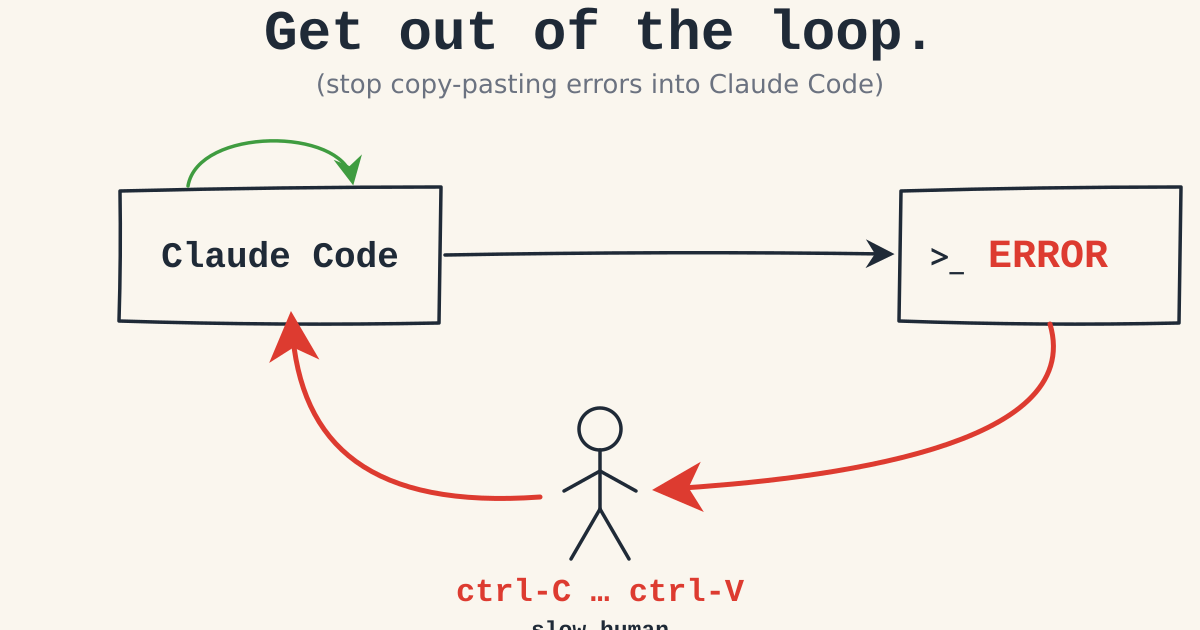
When Claude Code writes something that breaks, the reflex is to copy the error out of your terminal and paste it back in. Don't.
Every time you do that, you're slowing down. To write the code, Claude did thousands of autonomous tool calls and file edits. It tested the work locally to the best of its capability (but clearly not good enough) by running bash commands, unit tests, and more. It's the most gloriously fast engineering experience humanity has ever created. And there you are in the middle of it with your pudgy fingers hitting ctrl-c, ctrl-v. It reminds me of the doctor I saw last week at the medical clinic who spends 10% of his time diagnosing the patient and the other 90% stabbing his keyboard - one key at a time - for 10 minutes, only to write 3 sentences.
The whole point of coding agents is that you need to get out of the way! If you're copy-pasting errors then clearly the agent was not able to check its work properly. So stop and ask yourself why:
- Did you find an issue that Claude did not, because you ran the webserver end to end, connected to a real database? Good, now give Claude Code an API key to the database and get out of the way. No need for copy-paste next time. (And to be clear, that should be a staging database with no production data.)
- Did you open a browser and see some visual bug, which Claude did not? Easy, give Claude Code a headless browser and login credentials.
- Did you run an AI agent you develop and find some failure mode where the agent gives the wrong answer? Great, give Claude an LLM API key so it can run the agent, and let it write evals and reproduce the scenario end to end, then fix it. We do this every day when developing HolmesGPT and it works great.
- Are you unable to run your app end to end without a full AWS account or K8s cluster? We give Claude Code API keys to isolated cloud accounts so it can test HolmesGPT, and you can do this too.
If you want to start implementing this, I wrote some tips here.
Remember: your role as a software engineer is not to copy-paste. It's to do what you were always supposed to do: get computers to do things automatically, as reliably as possible. In 2026 that means diagnosing broken agentic loops and getting them to run longer without you. Notice the places that AI slows down because you're needed. Fix it. Find another slowdown. Get out of the way again.
Now back to my Claude Code. I kicked off a few new features when I started writing this post. They're ready and tested by now. I'll do some manual verification, but from past experience I won't find any issues. Claude Code did not write bug-free code on the first attempt, but by now it's found the bugs and fixed them.
Update: a few people read this post as recommending you give Claude your production database. That wasn't the intent and I've added a clarification above. We only do this with staging databases that hold no sensitive data.

Natan Yellin, CEO. Natan has been writing software for over 15 years. He regularly posts on LinkedIn.